
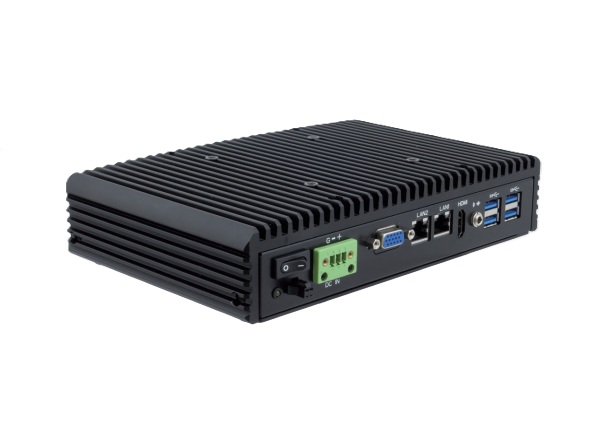
When businesses need reliable computing for demanding environments, the choice between an industrial computer and a commercial desktop or laptop can make or break operations. While consumer PCs are designed for office and home use, industrial computers are purpose-built to perform in conditions that would quickly destroy standard hardware.
Here are ten critical differences that explain why organizations across manufacturing, transportation, energy, healthcare, and defense choose industrial computers.
1. Operating Temperature Range
Commercial PCs are designed to operate between 0°C and 35°C (32°F to 95°F) — essentially a climate-controlled office.
Industrial computers routinely support operating temperatures from -20°C to 60°C, with extended-temperature models rated for -40°C to 70°C or beyond. This means reliable operation in:
- Freezer warehouses and cold chain logistics
- Desert oil fields and solar installations
- Unheated factory floors in northern climates
- Vehicle-mounted applications in all seasons
2. Fanless, Ventless Design
Commercial PCs rely on fans and vented enclosures to cool internal components. This creates two problems in industrial settings: fan failure and contaminant ingress.
Industrial computers use passive cooling through heat-sink chassis designs that dissipate heat without fans or vents. No fans means:
- No moving parts to fail
- No dust, oil mist, or moisture pulled into the enclosure
- Silent operation for noise-sensitive environments
- Dramatically lower maintenance costs
3. Shock and Vibration Resistance
A commercial PC sitting on an office desk experiences almost no vibration. An industrial computer mounted on a CNC machine, inside a delivery truck, or on a ship faces constant mechanical stress.
Industrial computers are designed and tested to withstand:
- Random vibration from 5 to 2,000 Hz (per MIL-STD-810)
- Mechanical shock of 50G or more
- Sustained operational vibration from nearby machinery
This is achieved through solid-state storage (no spinning hard drives), socketed or soldered components, and reinforced enclosures.
4. Ingress Protection (IP Ratings)
Standard commercial PCs have no protection against dust or water. Industrial computers are available with IP65, IP66, and IP67 ratings, meaning they are:
- Completely dust-tight (no particle ingress)
- Protected against water jets (IP65/66) or temporary immersion (IP67)
This matters in food processing, pharmaceutical manufacturing, outdoor installations, car washes, and any environment where cleaning involves water or chemicals.
5. Extended Product Lifecycle
Consumer PC models change every 6-12 months. When a model is discontinued, finding replacement parts or maintaining software compatibility becomes difficult.
Industrial computer manufacturers commit to 5-7 year product lifecycles or longer, with:
- Guaranteed component availability
- Revision-controlled motherboards
- Long-term BIOS and driver support
- Drop-in replacement units for installed base
This is critical for regulated industries, embedded OEM applications, and any deployment where requalification is expensive.
6. Wide-Range Power Input
Commercial PCs require clean, stable AC power through a standard outlet. Industrial computers support:
- Wide-range DC input (typically 9-36V DC or 12-48V DC)
- Vehicle power compatibility (with ignition control and voltage spike protection)
- Power-over-Ethernet (PoE) for simplified cabling in some models
- Built-in surge and transient protection
This enables deployment in vehicles, remote sites, solar-powered installations, and anywhere stable AC power isn't available.
7. Industrial I/O and Connectivity
An office PC offers USB, HDMI, and maybe one Ethernet port. Industrial computers provide:
- Multiple RS-232/422/485 serial ports for PLCs, sensors, and legacy equipment
- Dual or quad Gigabit Ethernet with teaming support
- Digital I/O (GPIO) for direct hardware control
- CAN bus for vehicle and machinery networks
- Multiple USB ports with locking connectors
- DIN rail or VESA mounting options
These aren't add-ons — they're built into the motherboard for maximum reliability.
8. 24/7 Continuous Operation
Commercial PCs are designed for intermittent use — 8-10 hours a day with regular restarts. Industrial computers are built for continuous 24/7/365 operation with:
- Higher MTBF (Mean Time Between Failures): 100,000+ hours vs. ~30,000 hours
- Industrial-grade components rated for continuous duty cycles
- Watchdog timers for automatic recovery
- Remote management capabilities (IPMI, Intel AMT/vPro)
9. Regulatory and Safety Certifications
Deploying computing equipment in industrial, marine, or hazardous locations requires specific certifications that commercial PCs don't carry:
- UL/cUL (electrical safety for US/Canada)
- CE (European conformity)
- FCC Class A (industrial EMI limits vs. Class B for consumer)
- EN 60945 (marine equipment)
- ATEX / Class I Div 2 (hazardous locations)
- E-Mark (in-vehicle equipment)
- MIL-STD-810 (military environmental testing)
10. Total Cost of Ownership
While an industrial computer costs more upfront than a consumer PC, the total cost of ownership over 5-10 years is typically lower:
| Cost Factor | Commercial PC | Industrial Computer |
|---|---|---|
| Unit price | $500-1,500 | $1,500-5,000 |
| Replacements over 7 years | 3-4 units | 1 unit |
| Downtime costs | High (unplanned failures) | Minimal |
| Maintenance | Regular (fan, HDD replacement) | Near-zero |
| Site visits for replacement | Multiple | Rare |
| Requalification/recertification | Each replacement | Once |
When you factor in downtime costs — which in manufacturing can reach thousands of dollars per hour — the industrial computer pays for itself quickly.
When Should You Use an Industrial Computer?
Choose an industrial computer when your application involves any of these conditions:
- Temperature extremes (below 0°C or above 40°C)
- Dust, moisture, or chemical exposure
- Vibration or mechanical shock
- 24/7 unattended operation
- Remote or difficult-to-access locations
- Long deployment lifecycles (5+ years)
- Regulatory compliance requirements
- Vehicle or mobile installation
Conclusion
Commercial PCs and industrial computers are built for fundamentally different purposes. Using a consumer PC in an industrial environment leads to premature failures, unplanned downtime, safety risks, and higher long-term costs.
Industrial computers are engineered from the ground up for reliability, longevity, and performance in the conditions where your business actually operates — not just in a climate-controlled office.
Acnodes Corporation offers a complete line of industrial computers, panel PCs, and embedded systems designed for your most demanding applications. Contact us for expert guidance or request a quote today.